

How to see “impossible colors”
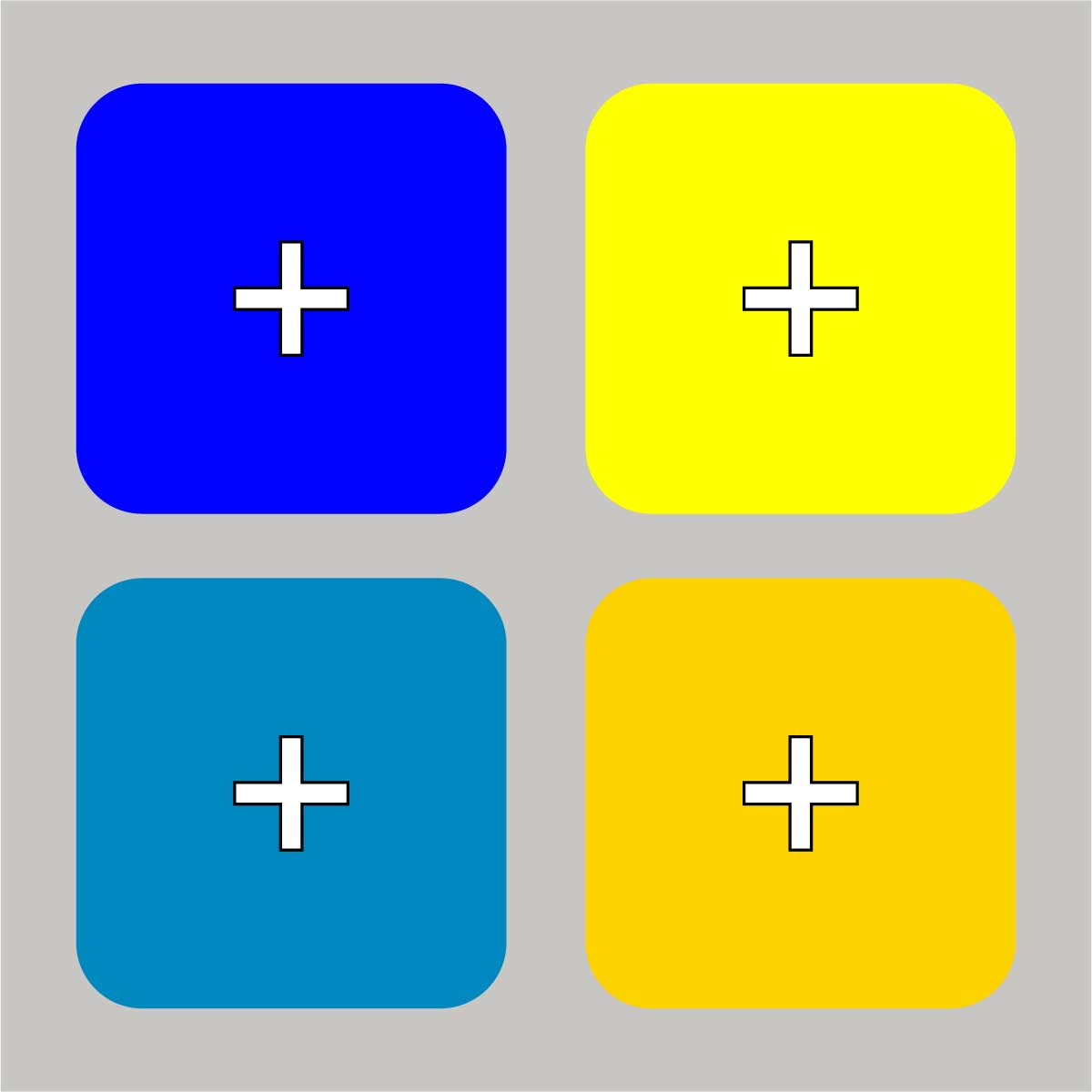
What does “reddish green” look like? Not brown, not olive — an actual color that’s simultaneously red and green the way cyan is simultaneously blue and green. You can’t picture it. Neither can I. These are called “impossible colors and the reason is neurological. Our eyes have opponent color channels: one processes red versus green, another handles blue versus yellow. These channels work by opposition — when one fires, it suppresses the other. Red and green can’t both be “on” at the same intensity any more than a light switch can be up and down simultaneously. The same goes for blue and yellow.
Some researchers claim they’ve made people see impossible colors through special visual experiments. In one technique, subjects stare at adjacent red and green stripes until the boundary dissolves. Some report perceiving a color they’ve never seen before — neither red nor green but somehow both. Others have used eye-tracking to stabilize images on the retina, preventing the normal flicker that allows opponent channels to take turns. The results are disputed. Some subjects report transcendent experiences; others just see mud.
Whether impossible colors can truly be perceived or are just an artifact of exhausted neurons remains debated. But the attempt reveals something profound: color isn’t “out there” in the world. It’s a construction of our brains, with hard limits built into the architecture.
Magenta is a color that exists only in the brain. It can’t be found on the electromagnetic spectrum.
When I cross my eyes for the red-green color, it first shades from red to green across, then it flickers between red and green, and then settles into a kinda orange-ish color for a moment before my eyes can't take being crossed any longer. the orange-ish color is, perhaps, the alleged impossible color, but it wasn't that impressive. Maybe I can't see it. Interesting nonetheless.