

How reusable heat packs work
The pouch holds supersaturated sodium acetate, and snapping the metal disc seeds crystals that fall out of solution and hit 130°F.
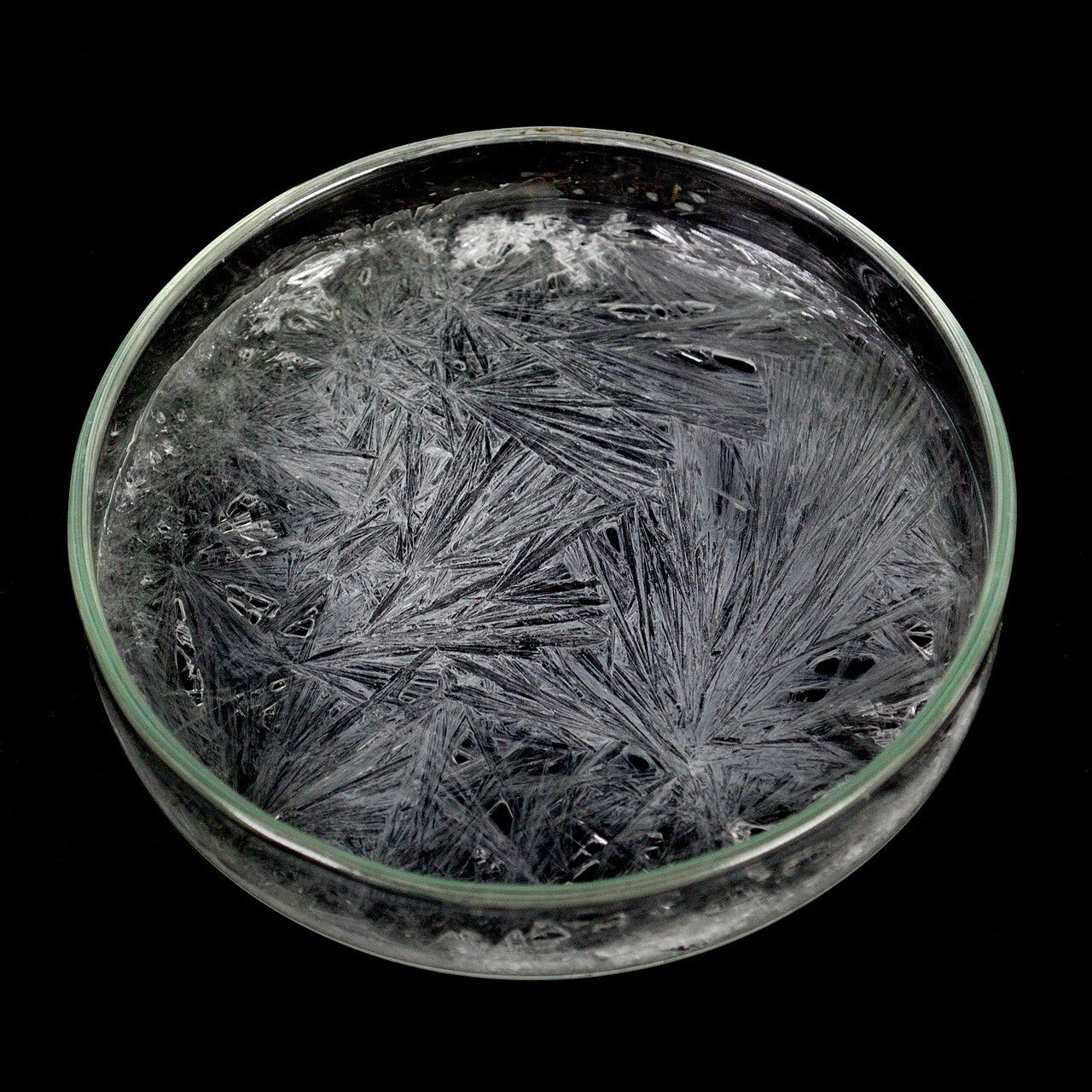
I took a home blood test today, and it included a reusable heat pack. These things have been around since the 1970s, but this was the first time I've used one. It's a plastic pouch with liquid inside and a small metal disc stamped with many dents. The disc is concave, and when you snap it, crystals start to form around the disc and spread rapidly throughout the pack. The liquid becomes semi-solid and gives off heat. I was curious about how they worked, so I read up on them, and this is what I learned.
The liquid in the pouch is water and a salt called sodium acetate. It's non-toxic; in fact, it's the ingredient that gives salt-and-vinegar chips their tangy flavor. You can dissolve a lot more salt in boiling water than in room-temperature water, so that's what the makers of these heat packs do. When the water cools down the salt stays dissolved. This liquid is called a supersaturated solution. The liquid is unstable and waiting for the first opportunity to solidify.
That's where the disc comes in. Snapping the disc kicks off the crystallization chain reaction. I thought the disc created a tiny shockwave that perturbed the solution, but the physicist Bjørnar Sandnes tested that idea and several others and found they were all wrong. The marks in the disc are slits stamped through the metal and flattened so the torn edges press against each other, with a few sodium acetate crystals clamped in between. When you click the disc, it exposes those crystals to the liquid, and the dissolved salt rapidly falls out of solution.
The process of crystal formation releases energy, causing the temperature to rise. When stored thermal energy is released, it's called an exothermic reaction. In this case, the pouch temperature hits about 130°F (54°C).
So why don't those crystals melt when you boil the pack? Because they are squeezed. The pressure where the torn edges meet reaches tens of thousands of atmospheres, and that raises the melting point so high that sodium acetate clamped between steel has survived 166°C. If you flex the disc too often while the pack is liquid, you might wash the seeds out, which is why some packs stop working. Sandnes suggests flexing it once or twice before you melt it, to make sure the trigger is charged with seeds.
And the process is reversible. You can recharge the pack by putting it in boiling water, which pumps energy back into it. The salt will dissolve and you'll end up back where you started with a supersaturated liquid.
Here's the 1976 patent application if you want to learn more.
How I use AI. Fountain pen source: pages 46 and 47. Pangram: rough draft, final draft.

As always, there's a Technology Connections for this:
https://youtu.be/Oj0plwm_NMs?si=IqTkyN_Ovh95LbxK
Take it away Alec...