

Googly eyes can help sell "ugly" produce
Gail Sherman / 11:42 am PT Mon Sep 9, 2024
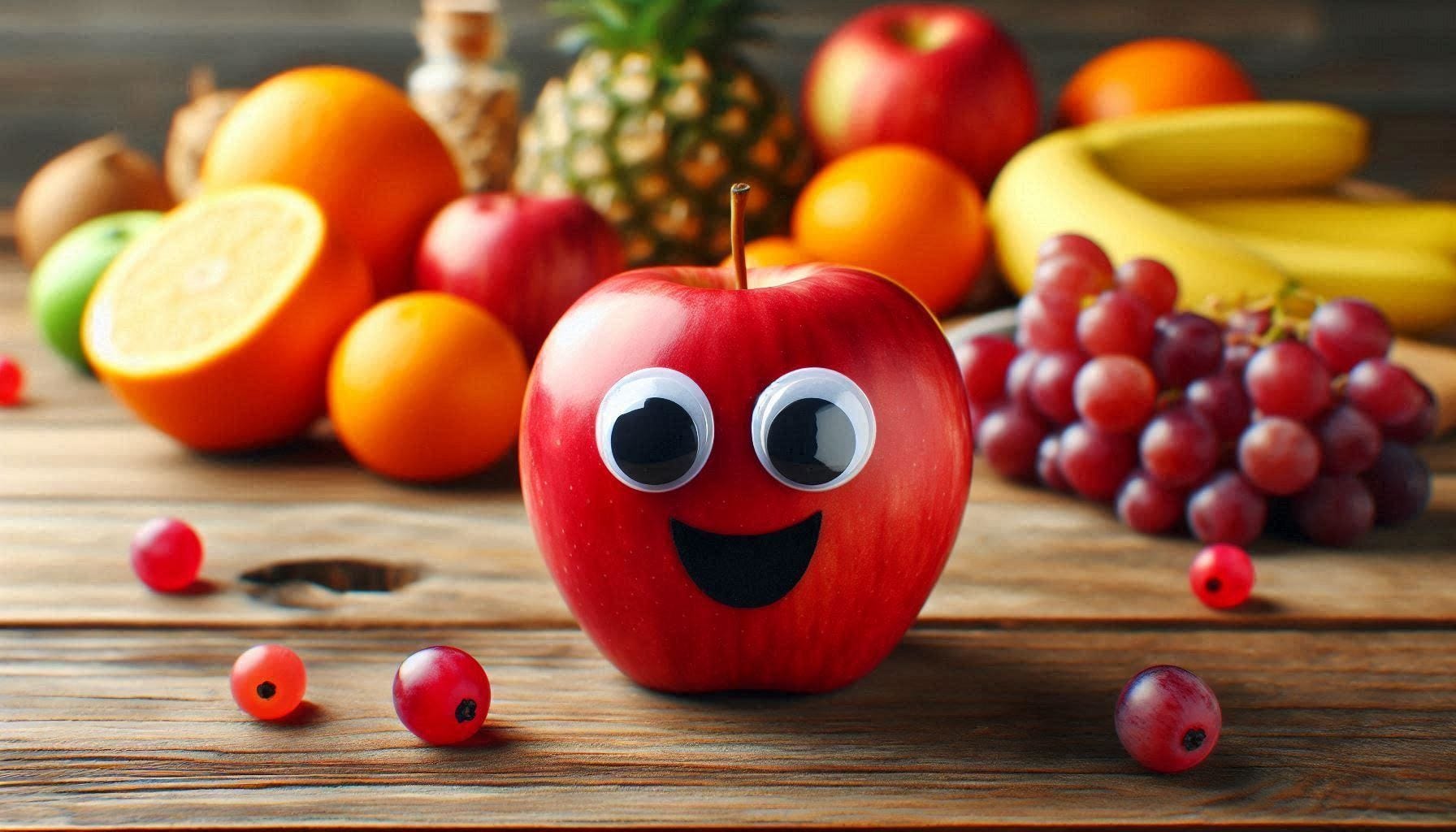
Image: DALL-E
In the United States, we waste approximately 30-40% of our food supply, or approximately 133 billion pounds of food. While some of this is caused by storage issues or over-purchasing, up to 20% of produce waste is perfectly good food considered too ugly for Americans to purchase.
Kacy Kim, an associate professor at Bryant University, recently published a study in the journal Psychology & Marketing with an adorable solution to the food waste problem: googly eyes.
As reported in Grist:
Kim's team argues that the problem is that supermarkets, and even "ugly" food specialty companies, are going about it all wrong. It's not about discounting irregular produce to try and get people to buy it, it's about making that produce appealing enough that it doesn't need to be discounted in the first place. That's where the googly eyes come in.
"By testing and adding some human characteristics, we examine whether that effort will increase the attractiveness of the produce, and [whether] that attractiveness is going to be increasing the purchasing of the produce and consuming of the produce," said Kim.
Kim's team found that giving ugly produce human names like Taylor or Jordan also made it more appealing. Anthropomorphism for the win! While a weird-looking apple named "Jordan" with googly eyes sounds cute, it does raise the question of how to dispose of all the googly eyes.
Previously: Chinese restaurant busted for dumpling-eating challenge due to food waste
Freaky truth behind the X-rays of the woman teeming with parasites from eating pork
Allan Rose Hill / 11:11 am PT Mon Sep 9, 2024

The X-ray images above were making the rounds in recent weeks. They purportedly depict a Chinese woman's legs teeming with parasites that took up residence in her body after a decade of eating raw pork. Is this for real? Snopes investigated and, yep, the images are real. The story is mostly true too, although apparently she had been eating raw meat for 13 years, not 10. It's also undetermined how often she ate it.
China National Radio was the first to report on the sad case from the Yunnan province:
Tingting (pseudonym), 23 years old, is from Yubeng Village, Deqin County, Diqing Tibetan Autonomous Prefecture. Recently, she, who had been in good health before, suddenly developed symptoms of headache and thigh pain. Then, unexplained pain appeared in many parts of her body. In severe cases, even her eyes would hurt, and she would keep crying. After this situation lasted for more than a month, Tingting went to the Department of Neurology of the Provincial First Hospital for treatment last week. In order to find out the cause of Tingting's body pain, the doctor suggested that she first do a brain MRI and a full-body CT scan. After getting the test results, even the experts who have been practicing medicine for many years exclaimed: "It's incredible." – From various imaging examination data, Tingting's brain, back of the eyeball, thighs, abdominal wall, back muscles are full of worms, and even the tongue and facial muscles are infected. The blood test further confirmed that Tingting's cysticercosis antibodies were positive, which was a cysticercosis infection[…]
After careful questioning, the mystery of Tingting's headache was finally solved. "We eat raw pork on the day of slaughtering the pig."
I hope Tingting is recovering.
(Thanks, Chanté McCormick!)
Previously:
• Tapeworms took up residency in Florida man's brain after he ate undercooked bacon
• Someone is mysteriously dumping massive amounts of raw meat in suburban Christchurch trash cans
Actual human indicted for making millions off of AI music
Thom Dunn / 10:18 am PT Mon Sep 9, 2024

Image: Public Domain via PxHere
52-year-old Michael Smith of North Carolina was indicted on federal charges on Thursday, September 5, 2024 for allegedly making millions of dollars off of streaming services by using AI-generated music over the last seven years. Charges include wire fraud and money laundering conspiracy.
At first, Mr. Smith was just making basic loops on his computer, uploading them to Spotify, then creating tens of thousands of fake accounts which would repeatedly stream the songs all day. From The New York Times:
According to a financial breakdown that he emailed himself in 2017 — the year that prosecutors say he began the scheme — Mr. Smith calculated that he could stream his songs 661,440 times each day. At that rate, he estimated, he could bring in daily royalty payments of $3,307.20 and as much as $1.2 million in a year.
This worked well enough for a while. But starting in 2018, he teamed up with an executive from an AI music company to automate even the loop-making process. Also from the Times:
The compositions would arrive to Mr. Smith with file names like "n_7a2b2d74-1621- 4385-895d-ble4af78d860.mp3." Then, he generated plausible names for the songs and their artists: "Zygopteris," "Zygopteron," "Zygopterous," "Zygosporic" and so on.
In a world with real bands called Dirty Projectors, Neutral Milk Hotel and Sunn 0))), real albums like "Yankee Hotel Foxtrot" and real songs like "MMMBop," the titles did not stand out.
By June 2019, Mr. Smith was earning about $110,000 each month, with a portion going to co-conspirators, the indictment said. In an email in February of this year, Mr. Smith bragged that he had reached 4 billion streams and $12 million in royalties since 2019.
This is hardly the only fake-music problem plaguing the streaming ecosystem recently. As writer Andy Vasoyan reported in Slate last month, there has also been a recent increase in uploads of cover songs by fake bands, many of which seem to be AI-generated as well:
Covers of popular songs were being inserted into large, publicly available playlists, hidden among dozens of other covers by real artists while racking up millions of listens and getting paid.
The artists "performing" the covers—the Highway Outlaws, Waterfront Wranglers, Saltwater Saddles—all fit a certain pattern, with monthly listeners in the hundreds of thousands, zero social media footprint, and some very ChatGPT-sounding bios. A group of vigilante Redditors initially found the pattern in bands covering country classics, but a wider look showed that there were groups covering songs across decades and genres. None of the bands had originals, but a group might cover the Red Hot Chili Peppers and Third Eye Blind and then pivot to "Linger" by the Cranberries in the same record. If you didn't think the song was A.I., you probably wouldn't suspect a thing.
Spotify doesn't technically have a policy against the use of generative AI in music creation; in fact, some people believe that Spotify may be rigging the game by padding playlists with its own fake artists. However, these fake cover bands could potentially be violating the company's policies against deceptive content.
Meanwhile, Spotify stopped paying out for songs by actual humans that get less than 1,000 plays, even though those songs still generate money for the company. This might not sound too crazy until you realize that that accounts for 2/3 of the content on the streaming service. That's a lot of money—that's now getting paid out to executives and, it seems, AI scammers.
The Bands and the Fans Were Fake. The $10 Million Was Real. [Maia Coleman / The New York Times]
Spotify Has a Fake-Band Problem. It's a Sign of Things to Come. [Andy Vasoyan / Slate]
Disclosure: I also write for Wirecutter, which is owned by the New York Times Company, which also publishes The New York Times
Donald Trump's "best people" will not vote for him again
Jason Weisberger / 10:07 am PT Mon Sep 9, 2024
The Harris campaign has released an ad showcasing that Donald "Adjudicated Rapist" Trump has lost the support of all his "best people."
I hope all the Republicans who have experienced a Trump administration and said "no" at least give moderates more room to abandon the sinking GOP's ship. These folks, Mike Pence at the front of the line, all worked with Trump to do horrible things, but even they can no longer stand by him. Screwing people over inside the rules seems just fine, but Donald colors so far outside the lines they can't stand by him any longer.
"The Best People" features the voices of Vice President Mike Pence, Secretary of Defense Mark Esper, National Security Advisor John Bolton, and Chairman of the Joint Chiefs of Staff General Mark Milley.
It is part of a $370 million digital and television advertising package the Harris campaign plans to unroll between Labor and Election days.
A press release announcing the campaign ad rollout includes comments from, among others, former Trump White House Chief of Staff, Homeland Security Secretary, and U.S. Marine Corps General John Kelly.
Previously:
• The best person who ever lived is an unknown Ukrainian man
Gun owners urged to stop storing firearms in ovens after overheated pistol fired five rounds
Rob Beschizza / 10:03 am PT Mon Sep 9, 2024

The remains of the gun, as posted by Chesterfield FD
Happiness may be a warm gun, but this one couldn't take the heat. Firefighters in Chesterfield, Virginia, responded to a reported explosion only to find it caused by a gun left in an oven. The owner had forgotten to remove it before turning the appliance on.
"Please do not store guns or anything else in your oven," Chesterfield Fire and EMS said in a social media post, suggesting a gun safe instead. [via WWBT]
This is not quite an isolated occurence. In 2018, a gun owner was shot by their own firearm after having left it in an oven. As Carla wrote then:
In the process of trying to secure the gun, Garlock forgot to put on an oven mitt and burned himself. He was also struck twice with bullets. Lucky for him he was "severely injured" but is doing okay.
Local news affiliate WWBT posted a report on the freshly fricaseed firearm, embedded below
This robot is controlled by a living mushroom (video)
Allan Rose Hill / 9:53 am PT Mon Sep 9, 2024

image: Cornell University
Researchers have bridged the gap between mushrooms and machines. Cornell University and University of Florence engineers demonstrated how a mushroom's mycelium, the thread-like networks comparable to roots, can be woven into electronics. The mycelium generate electrical signals in response to light that are translated into control commands for the robot.
"In this case we used light as the input, but in the future it will be chemical," said Cornell professor Rob Shepherd of the Organic Robots Lab.
"The potential for future robots could be to sense soil chemistry in row crops and decide when to add more fertiliser, for example, perhaps mitigating downstream effects of agriculture like harmful algal blooms."
Somewhere in there is a fun science fiction story of robots controlled by Psilocybe cubensis,
Previously:
• Here's why we don't have robot butlers yet
• Squishy robots learn to bend, stretch and squirm on command
Young golden eagle attacks fourth human
Rob Beschizza / 9:47 am PT Mon Sep 9, 2024

(public domain)
A young golden eagle in Norway reportedly attacked a toddler on Saturday, seemingly the bird's fourth run at a human. Just last week hiker Francis Ari Sture tangled with the feathered menace and got a nasty cut on his face—he "thought a human was trying to shove him down the steep Norwegian mountainside." The youngster required stitches after the weekend attack.
Rushing down 50 meters (164 feet) of steep terrain covered in loose rocks, he panicked he'd slip. But falling unconscious was his biggest fear because the eagle potentially "would start to eat me."
Eagle expert Alv Ottar Folkestad told the AP that the eagle "likely had a behavioral disorder." All those attacked received stitches and medication for gouges.
What happened is "radically different from normal," Folkestad said, adding that the attacks were likely all by a female eagle born this year.
"Details in the plumage make me believe it is the same bird. The plumage means that no two golden eagles are alike," he said, adding that in the past days there were "favorable weather conditions" with high-altitude winds for the eagle to fly long distances over southern Norway.
They'll soon know for sure if a single bird was the culprit—the little girl's mother armed herself with a length of wood and killed it during the attack.
Previously:
• Watch: Crows attack a bald eagle while the bald eagle is attacking a seagull
• Injured eagle actually just fat
• Child-snatching eagle video created as student project
Boeing caves to avoid strike. Still no word on who will fix the planes
Jason Weisberger / 9:46 am PT Mon Sep 9, 2024

de-nue-pic/shutterstock.com
Beleaguered Boeing has conceded a 25% pay raise and many other concessions in an agreement union leaders say is "the best contract we've negotiated in our history."
After successfully landing its uncrewed due to safety issues, Starliner, Boeing has also managed to keep its union workers at their jobs. How long Boeing will continue to exist as a going concern remains unclear. Having lost tens of billions of dollars in the last five years, mounting debt, and increasing supply chain problems, at least Boeing won't have a strike to deal with. Boeing says they'll be around for generations, so there is that.
Boeing has reached a tentative deal with workers to avoid a major strike, the aircraft maker said late on Sunday. The company conceded a 25% wage increase and a promise to build its next commercial airplane at its Seattle area plants.
The deal with International Association of Machinists and Aerospace Workers (IAM), which represents some 32,000 Boeing employees, is the first of its kind in 16 years. It also includes a provision for improving retirement benefits and gives the union more power in reviewing safety and quality procedures.
"Although there was no way to achieve success on every single item, we can honestly say that this proposal is the best contract we've negotiated in our history," the local IAM branch said. They had initially been seeking a 40% wage increase.
Stephanie Pope, the CEO of Boeing's commercial aircraft branch, said the deal promised "job security for generations to come."
Scientists make temporarily transparent mice
Jennifer Sandlin / 9:21 am PT Mon Sep 9, 2024

Scientists have found that massaging tartrazine—aka "Yellow 5," aka the food dye used in Doritos—into the skin of mice can temporarily make the mice transparent. The Washington Post explains that in a recent study, researchers found that about five minutes after applying the dye, "the opaque skin of the mice transformed temporarily into a living window, revealing branching blood vessels, muscle fibers and contractions of the gut." Popular Science describes the process:
The method is simple. In short, massaging tartrazine solution into hairless mouse skin over the course of a few minutes or using microneedling achieves "complete optical transparency in the red region of the visible spectrum," per the study. Wash the dye away, and the skin returns to its natural, opaque state.
Scientist Christopher Rowlands, who Popular Science interviewed, was blown away by the discovery:
"I instantly looked at it and went, 'my god, this is revolutionary,'" says Christopher Rowlands, a senior lecturer and biophotonics researcher at Imperial College London. Rowlands wasn't involved in the study, but wrote an accompanying perspective article on it after he acted as a reviewer for the research. "In optics, we spend an awful lot of time trying to increase [how well we can see into tissue] by 20 percent or 50 percent. These guys come along and they annihilate the boundary by a factor of 10." The most advanced current optical imaging (i.e. non-invasive, and not reliant on radiation) techniques might allow a scientist to see a couple of millimeters into live tissue, but the new method could make detail more than a centimeter deep visible to the naked eye, says Rowlands. "It's not magic, but it's still very powerful," he adds . . .
The physics concepts involved in the process are so fundamental that, "I was kicking myself that I hadn't thought of it," Rowlands tells Popular Science. "It's one of these moments where it's blindingly obvious, but you need somebody else to tell you it first. It makes so much sense in retrospect." It's a "triumph of fundamental understanding," he adds, which demonstrates what happens when a deep understanding of a theory comes together with real-world experimentation.
The Washington Post addresses the physics of the phenomenon:
How does bright yellow food coloring turn tissue transparent? To understand why, it's essential to consider the reason things look opaque in the first place. The bits of our body — cell membranes, proteins, fluids — all cause light to refract, or bend.
If light bends just once — think of a beam of sunlight hitting a sheet of glass — the image it carries is still mostly clear. But as light refracts over and over, off fluids, proteins and other cellular miscellany, it scatters in lots of directions. All that scattered light, Rowlands said, makes it hard to see through — "like watching TV through a glass of milk." . . .
By applying textbook physics principles, the researchers were able to screen for molecules that they predicted would, when absorbed by the body, change how biological tissues refract light. They hit on tartrazine, dissolved in water. But the proof was in the experiment. They soaked a slice of raw chicken in a tartrazine solution and found that the chicken turned clear as they increased the amount of tartrazine. When they rubbed that solution onto the skin of mice, they saw internal organs come into view. The tartrazine reduced the amount of refraction, the light scattered less and the tissue appeared clear.
Popular Science further describes the relevant physics concept, the "Kramers-Kronig relations":
"Biological tissues, like skin, are usually not see-through because light gets scattered as it passes through them," says Guosong Hong, co-senior study author and a bioengineer at Stanford University. Animal flesh is a matrix of different materials, mostly water and fats, and these two types of compounds refract light at different angles, he explains. A light particle, or photon, traveling through tissue under normal circumstances moves from water particle to lipid particle, being bounced around, taking a long, winding path, and oftentimes being absorbed by one of the many molecules it collides with along the way.
But tartrazine dye, through its powerful absorption of blue wavelengths of light, changes the refractive index of water to be much closer to that of fat, Hong says. This happens through a basic physical principle called the Kramers-Kronig relations, which dictates that waves (like those of light–which is both a particle and a wave) are the result of predictable signals. As a result, a photon can pass through skin almost as if the tissue were homogenous. It takes a shorter path, avoiding all of the bouncing and angle changes that increase the likelihood of light absorption, ultimately illuminating the inside of a mouse.
The effect is temporary, as the tissues return to normal when the dye is washed off with, as The Washington Post reports, "minimal systemic toxicity" for the mice.
So, besides the cool sci-fi factor, what's the point? Again, The Washington Post:
The technique may help scientists answer long-standing questions in biology — for example, allowing researchers to observe a mouse's brain activity, including in the deepest parts of the brain. It could be used to diagnose deep-seated tumors without surgery, help locate a vein for a blood draw or make cosmetic procedures like tattoo removal more precise, said Guosong Hong, a materials scientist at Stanford and one of the study's leaders.
Video below or click through to this Popular Science article to see an image of the transparent mice. And no, I'm pretty sure rubbing your belly with Doritos dust won't suddenly make you transparent.
Remote Indigenous tribe kills encroaching loggers in Amazon
Allan Rose Hill / 9:04 am PT Mon Sep 9, 2024

image: Survival International
The Mashco Piro, an Indigenous tribe in the Peruvian Amazon, have had almost no contact with the outside world and we should leave them alone. Unfortunately, logging companies are now operating just miles from their home. The Mashco Piro have been frequently emerging from the rainforest in recent months as the loggers increase in numbers and proximity. Last month, the Mascho Piro reportedly attacked loggers with bows and arrows. A few days ago, the Maschi Piro reportedly killed two of the intruders threatening their ecosystem and way of life.
FENAMAD, an organization representing several dozen Indigenous communities in the region, claims they have warned the government that the situation will only intensify unless the ancestral land is protected.
From the AP:
The attack took place a day before the Forest Stewardship Council suspended the sustainability certification of a logging company for eight months which rights groups and activists have accused of encroaching on the Indigenous group's land.
"It's absurd that certifiers like the FSC keep the certification of companies that clearly and openly violate basic human rights and Indigenous rights," said Julia Urrunaga, director of the Peru program at the Environmental Investigation Agency. "How terrible that people have to keep dying and that it has to be an international scandal for action to be taken."
Previously:
• Rare photos of uncontacted tribe now threatened by logging companies
Gallery has 10,000 polished spoons and a sparkling "spoondelier"
Popkin / 8:59 am PT Mon Sep 9, 2024

I love niche museums that are dedicated to one specific thing. The Mississippi Spoon Gallery, which came onto my radar through Atlas Obscura, is a lovely collection of over 10,000 spoons, both new and old. They say they are the world's largest souvenir spoon collection on display.
This unique museum located in Davenport Iowa was created by Cammie Pohl, who became obsessed with collecting rare utensils over 3 decades ago when her great-grandmother gave her a set of antique spoons. If you'd like to donate any old spoons to the museum, you can do so through the museum's website here.
From Atlas Obscura:
"Among the highlights here are spoons from the Chicago World's fair of 1893 and 1933, spoons designed for both the U.S. Army and Navy, spoons from the Iowa State Fair, and spoons for Queen Victoria and Queen Elizabeth II's. Perhaps most visually striking is the "spoondelier," a chandelier made of gleaming tableware hanging from the ceiling."
See also: Museum invites public to visit naturism art exhibit completely naked (except for shoes)
New Retroid Pocket gaming handhelds officially support Linux
Rob Beschizza / 8:50 am PT Mon Sep 9, 2024

Retroid Pocket Mini
Retroid's Pocket Mini and Pocket 5 gaming handhelds come with official support for Linux, including Armbian and the all-in-one retrogaming distro Batocera. I love the little 4:3 AMOLED display on the Mini–what's the largest OLED in that aspect ratio you can buy? There are bare-bones 8-inchers on Ali Express for reasonable prices but everything larger is either LCD or not 4:3.
The Mini is $200 and the Pocket 5 $250. The price reflects the high-end specs; if you're just wanting to SNES on the go, there no reason to spend more than $90 or whatever on Retroid's own well-reviewed 2S. I found a big thread on Reddit packed with info, discussion and useful links.

Previously:
• How to build a DIY radioactive handheld video game console
• SEGA announces Game Gear Micro version of their classic 1990s handheld console
• Play free emulators of all those handheld video games of yesteryear
Support for banning Tik Tok evaporated in the summer heat
Rob Beschizza / 8:25 am PT Mon Sep 9, 2024

Photo: Constante / Shutterstock
American support for banning Tik Tok has collapsed, according to data released by Pew Research, falling from 50% to 32%. Meanwhile, opposition to the ban has gone up from 22% to 28%. Those who are not sure are up to 39% from 28% last year.
Tik Tok's head is still on the block, though. A bill requiring its sale by Chinese owner ByteDance passed in April and various shady-but-American interests are hoping to buy it. Republicans are still about twice as likely to want to see Tik Tok banned as Democrats, but both audiences saw a similar decline in support; at one point, nearly 2 in 3 Republicans supported a ban, but less Republicans now want it banned than Democrats did last year. Stats are magic!
Moreover, most Americans now think it unlikely Tik Tok will be banned, by a fraction of a percent, with less than a third thinking it likely: 50%-31%.
The whole "Ban Tik Tok" thing is bullshit of the floating world driven by fear of young people getting their politics from unsanctioned sources. Media interest in it subsided when the ban became real, because it's a censorship mechanism that was suddenly warming the hairs on some of our own necks. And in the absense of relentless coverage of the politicians calling for it, public interest subsided too. VORRRBloop!
Previously:
• How Tik Tok amplifies the consumerist fever dream of conspirituality
• Tik Tok executive refuses to say it will stop sending U.S. user data to China
• Donald Trump, who wants to ban Tik Tok, has joined Tik Tok: 'It's my honor'
Big Lots is bankrupt and selling itself to private equity
Rob Beschizza / 4:57 am PT Mon Sep 9, 2024

Robert V Schwemmer / Shutterstock
Last month, Big Lots announced it was closing 300 stores in hopes of staying in business. Alas, bankruptcy is now upon it, confirming earlier doubts over its ability to survive. CNN reports that Nexus Capital Management is acquiring "substantially all" of Big Lots stores and business operations as part of the filing.
"The actions we are taking today will enable us to move forward with new owners who believe in our business and provide financial stability, while we optimize our operational footprint, accelerate improvement in our performance, and deliver on our promise to be the leader in extreme value," wrote Big Lots CEO Bruce Thorn. No more stores will immediately close.
We also intend to continue optimizing our store footprint during the process. Though most of our stores are profitable, and we are taking every step possible to improve the profitability of all our stores, we will need to close certain locations to ensure that our business operates efficiently and we can continue serving our customers.
Once a trash palace packed with random "Not for retail sale" goodies, Big Lots transformed slowly into a place to buy inexpensive furniture and other "spend little less on large purchases" type stuff. LL Flooring is another recent casualty in that area, but had no private equity gray knight.
Previously: Shopping Cart Alignment Chart
Wind currently Britain's largest electricity source
Rob Beschizza / 4:45 am PT Mon Sep 9, 2024

A wind farm in England. Photo: flystock / shutterstock
Britons might be unsure about the growing potential for solar power there, but there's no question about the wind and tides. Electric Insights reports that wind power was the country's largest energy source in the second quarter of 2024.
"After a century of either coal or gas being our main source of electricity, wind power is now Britain's single largest source of electricity generation," it wrote in a PDF report covering the numbers. "Over the 12 months to April, Britain's wind farms produced 83 TWh of electricity, compared to 81 TWh from gas-fired power stations. Wind produced 32% of the country's demand, versus 31% from natural gas."
The report cautioned against spot measurements of wind, for the obvious reason: "It's important this is measured year-round, as this accounts properly for the intermittency of wind, which 'doesn't always blow.'"
Here's an illustrative chart, with pink for gas power and blue for wind, covering the last 14 years.
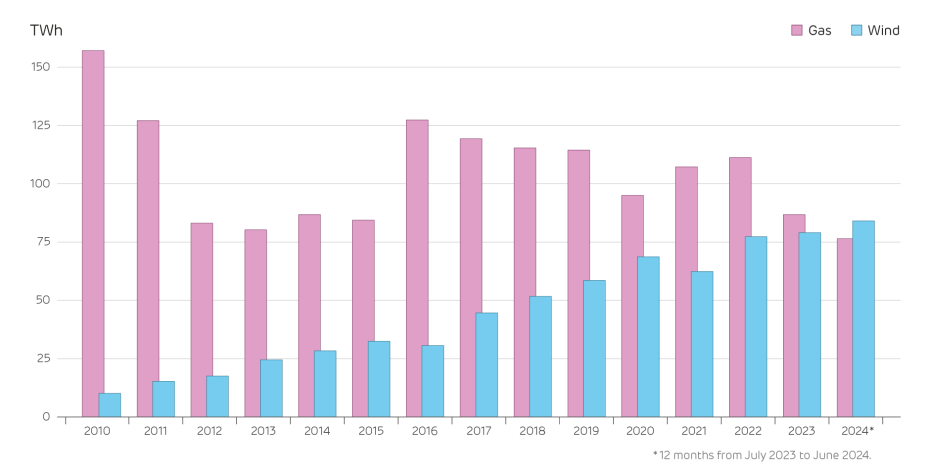
Denmark and Lithuania both went wind-powered about a decade ago, with Germany, Spain and Portugal catching the breeze last year. According to the report, several countries in Africa and Yemen are now predominantly solar-powered.
Mud Bowl celebrates 50th year
Rob Beschizza / 4:33 am PT Mon Sep 9, 2024

Screenshot via YouTube
Sunday saw the conclusion of three days of Mud Bowl (not to be confused with professional Mud Bowls), celebrating its 50th year in filthy fashion as football players trudge through a "pitch" of wet mud in North Conway, New Hampshire.
"You're playing football in the mud, so you've got to have a smile on your face," said Jason Veno, the 50-year-old quarterback of the North Country Mud Crocs, who described mud as an equalizer. "It's just a different game in the mud. It doesn't matter how good you are on grass. That doesn't matter in the mud."
Players describe an experience that stick with you.
"It gets in the eyes. You get cracks in your feet. And you get mud in your toenails for weeks," he said. "You get it in your ears too. You'll be cleaning out your ears for a long while …you'll be blowing your nose and you'll get some dirt and you're like, oh, I didn't know I still had that there."
The Associated Press posted a glorious gallery of mucky photos from the tournament/festival. Embedded below, some footage from a previous year's action.
Previously:
• The secret world of swamp mud
• 'Mud and Merchandise at Woodstock '94' compares the event with the original Woodstock festival of '69
• Imagine you work by paying $425 for artificially mud-stained jeans
Generic e-bike chargers deemed dangerous
Rob Beschizza / 4:17 am PT Mon Sep 9, 2024

Cheap generic chargers are untrustworthy, reports the USCSC
The U.S. Consumer Product Safety Commission is warning e-bike users to steer clear of generic "universal" chargers for their rides unless they've been specifically tested with it: "Chargers marketed as "universal" or suitable for general categories of micromobility devices may fit into your device but still be incompatible with it."
From the statement: Each micromobility battery has specific charging needs that require the use of a compatible charger. Chargers with descriptions such as "suitable for use with e-bikes" or "suitable for use with X brand e-bikes" may be incompatible with your device. Using an incompatible charger can cause the battery to ignite and result in a serious fire. Between January 1, 2023 and May 16, 2024, CPSC received 156 reports of fire and thermal incidents involving "universal" chargers for micromobility products, including reports of serious injuries and property damage. On September 5, 2024, CPSC issued a press release warning the public of the fire hazard posed by certain makes and models of these chargers. Use only the charger provided with your micromobility device.
The commission recommends "contacting the manufacturer of your device for information about compatible replacement chargers" and offers tips to avoid fires: first, unplug the charger once your device is charged, don't leave it on for extended periods of time in any case, and don't leave it on when you're not present or asleep.
Previously:
• The best federal agency just dropped the sickest mix tape of musical safety tips
• Dangerous coffee mugs leave consumers burned and bloodied
• Target recalls exploding candles after cases of lacerations and severe burns