

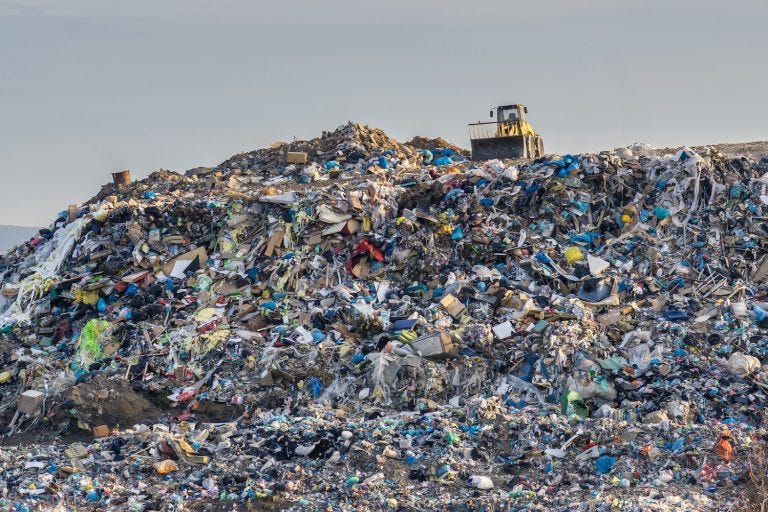
The war on litter was never intended to save the planet; it was created to protect polluters from accountability.
The “Keep America Beautiful” campaign taught us that litter is a moral failure. A personal flaw best corrected with shame, mascots, and finger-wagging slogans. But Current Affairs lays out, in an infuriating deep dive, how the anti-litter movement wasn’t born of environmental concern so much as corporate self-defense, designed to redirect blame away from companies that flooded the country with disposable packaging and place it on you and me.
A 1955 Life article dubbed this the era of “Throwaway Living.” A full-page photograph in the magazine features a grinning, white-bread American family beneath a flurry of disposable items: frozen food containers, paper napkins, diapers, foil pans, paper cups, and more. “These objects flying through the air in this picture would take 40 hours to clean—except no housewife need bother,” the page reads. “They are all meant to be thrown away after use. Many are new; others, such as paper plates and towels, have been around a long time, but are now being made more attractive.”
But there was one quickly growing problem with the disposable revolution, when combined with the mass-production of cars. More Americans on the freeways meant more trash piling up on the side of the road, but it also meant more people could see it. The public valued convenience, but they valued beauty too. Perhaps sensing a future PR problem—in that much of the unsightly garbage bore their logos—the American Can Company and Owens-Illinois Glass Company established the “Keep America Beautiful” nonprofit in 1953. Alongside leaders from major beverage firms like Coca-Cola and Anheuser-Busch, KAB ran local campaigns that preemptively framed pollution as an individual issue.
The article traces how industry-backed campaigns like Keep America Beautiful reframed a growing waste crisis as a failing of individual responsibility, teaching Americans to feel guilty for trash while corporations quietly normalize throwaway culture. From Iron Eyes Cody to cartoon enforcers like Susan Spotless, the movement perfected a kind of environmental gaslighting: you made the mess, so you clean it up. Never mind who manufactured the mess in the first place.
Remember, at its worst, consumer waste accounts for 30-40% of the problem, and corporate/industrial waste accounts for 60-70%. Some studies show consumer waste accounts for as little as 6-10% of the problem.
Thanks, David Wolfberg
Gaslighted for decades.