

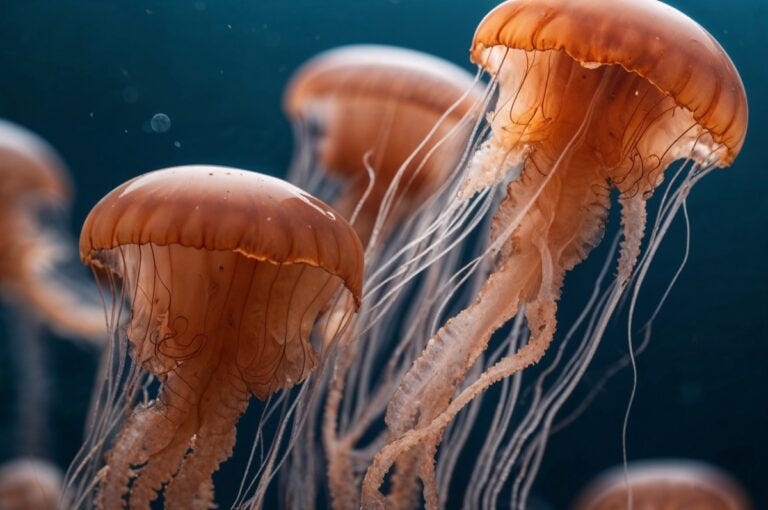
I recently watched this funny animation by Natural Habitat Shorts featuring a jellyfish named Bennett who is stressed out at work because he has to give an important presentation. Before he heads to the boardroom, his coworker urges him, “please don’t do the baby thing this time, PLEASE!” But it’s already too late, Bennett has already started whimpering, signaling that he’s begun his transformation. By the time he gets to the boardroom it appears that he’s fully become a babbling baby, much to his coworker Doug’s chagrin: “EVERYTIME WE PUT YOU ON AN ACCOUNT THAT ACTUALLY MATTERS, YOU PULL THIS CRAP!” he yells at the poor little baby. There’s a plot twist, though. That baby isn’t Bennett! It’s actually his boss’s baby jellyfish that he brought to the office for “Bring your child to work” day. And boy do the tables turn, as Doug himself turns into a crying baby when his boss berates him for yelling at his sweet, innocent baby.
What’s going on here? Natural Habitat Shorts succinctly explains: “When under stress the immortal jellyfish biologically resets itself, reverting to its juvenile form.” The Natural History Museum, London provides a longer description of this rare process, called “transdifferentiation.” The tiny hydrozoan Turritopsis dohrnii, which is smaller than the nail on your pinkie finger, can reverse its life cycle when experiencing stress. They go on:
. . . instead of dying it shrinks in on itself, reabsorbing its tentacles and losing the ability to swim. It then settles on the seafloor as a blob-like cyst.
Over the next 24 to 36 hours, this blob develops into a new polyp – the jellyfish’s previous life stage – and after maturing, medusae [adult jelly fish] bud off . .
Medusa cells and polyp cells are different – some cells and organs only occur in the polyp, others only in the adult jellyfish. Transdifferentiation reprogrammes the medusa’s specialised cells to become specialised polyp cells, allowing the jellyfish to regrow themselves in an entirely different body plan to the free-swimming jellyfish they’d recently been. They can then mature again from there as normal, producing new, genetically identical medusae.
This life cycle reversal can be repeated. In perfect conditions, it may be that these jellyfish would never die of old age.
Pretty cool, right?
Natural Habitat Shorts has created equally entertaining and informative animations highlighting a chipmunk at the grocery story carrying their purchases in their expansive cheeks, a mama opossum in the TSA line being asked to empty her pouch, which holds up to 20 joeys, and fire ants trying to escape the Titanic on a raft built from buoyant larvae.
In a great piece by CNN about Natural Habitat Shorts and others using humor to provide educational content online, its creators, Nicole Low, Brennan Brinkley, and Tyler Kula, explain that they’re trying to reimagine nature documentaries from the point of view of animals, and that the humor in the videos comes from showing animals experiencing human situations. Nicole Low states, “To animals, everything they do is very mundane. It’s just survival to them . . . This is how we must look to them filming their lives.”
Learn more about Natural Habitat Shorts on their website, and see more on their Instagram, YouTube, or Facebook. They try to post a new video every other Thursday.
