

AI agents have made self-hosting your own server fun for normies
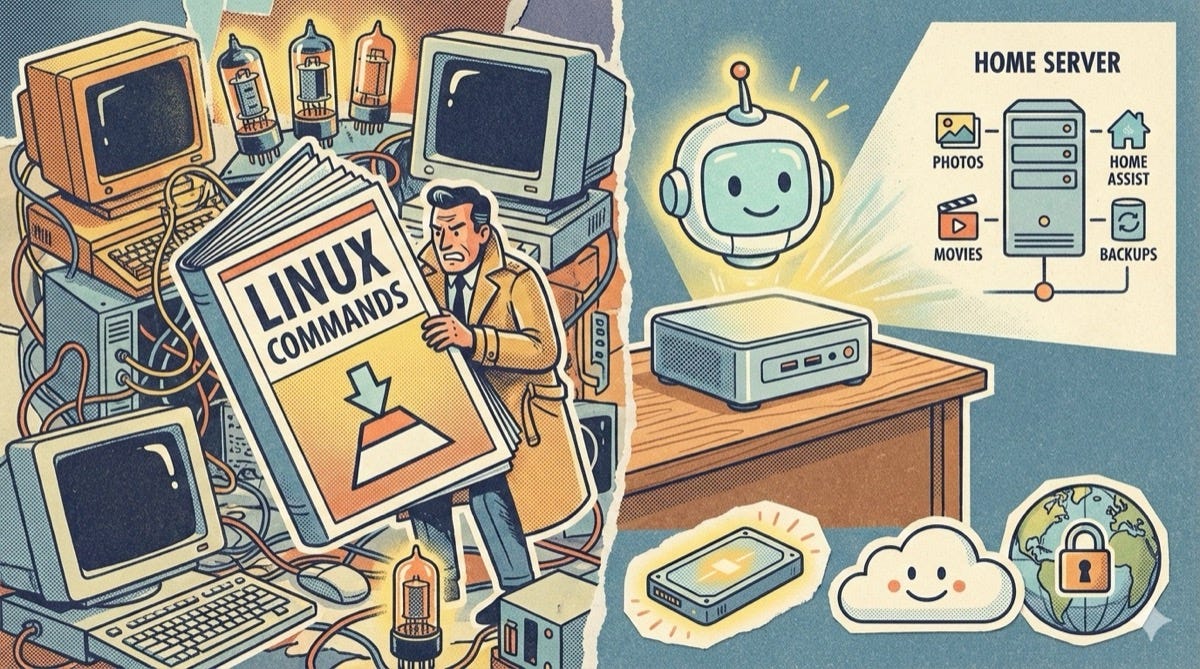
Running your own home server used to mean spending hours fighting with Docker configs, memorizing arcane Linux commands, and debugging networking issues at 2am. Developer Jordan Fulghum argues that 2026 is the inflection point where that changed — and the reason is CLI agents like Claude Code.
The pitch: a Beelink mini PC, an 8TB NVMe drive, and an AI assistant that actually knows how to configure things. Fulghum now runs 14 containerized services — Vaultwarden for passwords, Immich as a Google Photos replacement, Plex, Home Assistant, and more — all while his tiny server idles at under 10% CPU. Total hardware cost: around $700.
The real innovation isn’t the hardware, which has been cheap for years. It’s that you no longer need to become a sysadmin to make it work. When Fulghum needs to set up a reverse proxy or configure automatic backups to AWS Glacier, he just asks Claude Code to handle it. The agent reads documentation, writes configs, and troubleshoots errors — all the tedious parts that used to make self-hosting a chore.
Daily backups go to an external USB drive; weekly backups upload to Glacier for about 20 cents a month. The whole system runs through Tailscale for secure remote access without opening ports to the internet. For anyone comfortable with a terminal but tired of paying for a dozen SaaS subscriptions, this might be the moment self-hosting finally makes sense.
(hmm.... a post aggrandizing 'A.I.' by Ellsworth Toohey ... how em-dash-y) don't do it kiddies! actually learn something by setting-up your 'server' yourself. it's fun and educational and less likely to end up inviting in a hacker hoard by having the 'A.I.' blithely include an open SSH port (22) and a root password of 'admin'
I did an experiment w/ a new homelab setup and having AI generate documentation and step-by-step instructions. It failed on step 1. It was very well-written and fully believable garbage that only served to make me angry again at how people want some kind of cheat code for tasks. Of course, it also made me angry that for every Linux thing I want to set up (and I do it a lot), I need to go get my masters in non-uniform communications and assumed knowledge.
Oh, you want to set up a DHCP server, wait, you didn't already configure your firewall for the correct ports, wait, you didn't know what ports this uses, wait, of course we use custom ports because we practice obscurity security, wait, we don't document that of course because then it wouldn't be secure! LINUX!!!